Conservation at La Drymophila: 12 New Hectares of Andean Forest Protected
The first time we walked through the 12 hectares that now belong to La Drymophila, the first thing we heard was water. Three springs running down the mountain, disappearing into the moss and the trunks of the black oaks. Mist covered everything. And for the first time in years, that sound was no longer at risk.
These 12 hectares came very close to disappearing.
For years they were used for timber extraction, and more recently their future was completely uncertain. They could have ended up as monocultures. They could have been broken into pasture. They could have slowly faded away, like so many other Andean forests in Colombia.
But this time, something different happened.
After months of paperwork, legal processes, uncertainty, and a lot of hope, we managed to secure
12 new hectares of Andean forest in the La Mensura village, at 2,000 meters above sea level, adding them to the conservation effort of La Drymophila.
To some, 12 hectares may sound small.
For us — and for this corner of southern Huila — they mean water, connectivity, biodiversity, and future.
🌳 A Forest That Keeps the Andean Corridor Alive
The new land consists of advanced secondary Andean forest, with old-growth black oaks and several Colombian magnolia species listed as Critically Endangered.
The property also protects:
- Several streams flowing down toward the village water intake
- Three freshwater springs
- A key ecological connection between La Drymophila and the local aqueduct
These forests help conserve the water sources that supply roughly
5,000 people in the Roble, Jordán, and Juntas villages.
Beyond its local value, the property strengthens ecological connectivity toward
Cueva de los Guácharos National Natural Park — Colombia’s very first national park, and one of the country’s most important biodiversity strongholds.
In the Andes, connectivity is everything. When forests become isolated, wildlife populations fragment, genetic diversity declines, and many species slowly disappear from the landscape. This purchase helps prevent exactly that.
⏳ When Time Was Running Against the Forest
For years, this land was under constant pressure. Like so many other Andean forests in Colombia, its fate depended on a single decision.
That decision came at a difficult moment.
The previous owner — a campesino who had lived alongside this forest for decades — needed to sell urgently to cover a major back surgery. His timeline was weeks, not months. And for the forest there were no guarantees: within a short period of time, the 12 hectares could have been turned into pasture, intensive agriculture, or monoculture plantations.
Thanks to the support of an international donor committed to the conservation of the Andean–Amazonian corridor, and to the years of work our family has sustained in this region, we were able to close the purchase before the forest was transformed.
With that signature came something hard to describe: peace of mind.
The peace of mind of knowing these forests will stay connected. The peace of mind of protecting the streams and the springs. The peace of mind of securing habitat for the birds and other species that depend on these ecosystems.
“Conservation isn’t always about protecting one specific point of biodiversity. Many times, conservation simply means acting before the forest disappears.”
🐦 The Birds of the New Corridor
The forests surrounding El Encanto and La Drymophila are part of one of the most bird-diverse regions in the country. Between both reserves and their surroundings, we have recorded over
400 species, including endemics and threatened birds highly sought after by birders from around the world.
The new property protects critical habitat for some of the most emblematic birds of the southern Huila Andean–Amazonian corridor:
- 🔸 Black Tinamou (Tinamus osgoodi) — One of the most elusive and least-known tinamous in South America. Its deep dawn whistle is one of the most sought-after sounds for birders in the region.
- 🔸 Schwartz’s Antthrush (Chamaeza turdina) — A terrestrial bird of mature Andean forest: hard to see, easier to hear, and almost always tied to well-preserved forests.
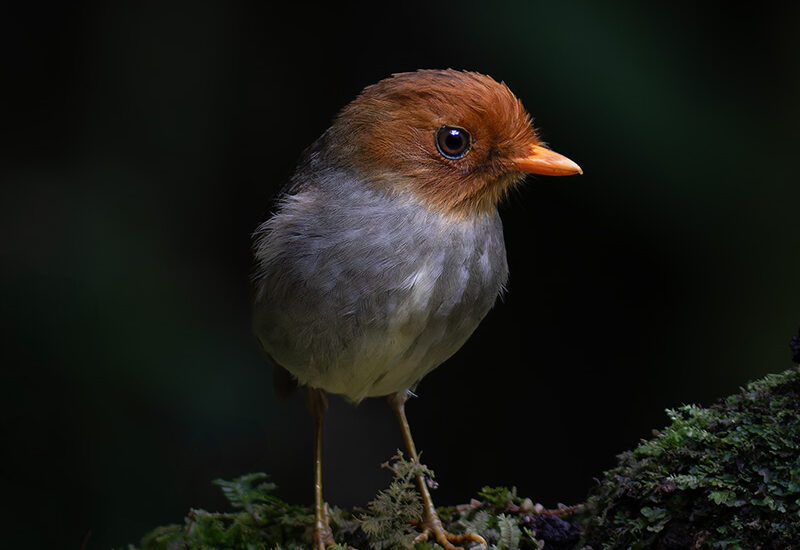
- 🔸 Hooded Antpitta (Grallaricula cucullata) — One of the smallest antpittas in Colombia and possibly the most sought-after by specialized bird photographers. Read more in our dedicated post about the Hooded Antpitta.
- 🔸 Dusky-headed Brushfinch (Atlapetes fuscoolivaceus) — Endemic to Colombia, with a restricted range mostly limited to the upper Magdalena valley. One of the jewels that defines this corridor.
- 🔸 Tolima Blossomcrown (Anthocephala berlepschi) — A Colombian endemic hummingbird, listed as Endangered. Finding it here is a clear reminder of why every hectare matters.
Although ecologically the new property shares many features with La Drymophila, its greatest value lies in
keeping the forest continuous — because when forests stay connected, life can keep moving between them.
👨👩👧 Decades of Family Work
What makes this story special is that the purchase of these 12 hectares didn’t appear overnight. It is the result of decades of family work in this corner of Huila.
Over the years, we’ve dedicated our time to:
- Forest restoration
- Bird conservation and biological monitoring
- Responsible nature tourism
- Environmental education with neighboring communities
- Feeding stations and specialized photography hides
- Sustainable projects that show conservation can also support a dignified life
Over time, that work allowed El Encanto and La Drymophila to grow into internationally recognized birding destinations — recognition reflected, for example, in
our profile published by the American Birding Association.
But beyond tourism, the goal has always been the same: to protect the forests that still survive in this region.
Adding these 12 hectares is one more step toward that vision.
🌱 What’s Next: A Civil Society Nature Reserve
Looking ahead, our plan is clear.
In the future, La Drymophila and this newly protected forest will become part of a
Civil Society Nature Reserve (RNSC) registered with Colombia’s National Parks system — a legal designation that strengthens private conservation and grants long-term protection to these ecosystems.
This expansion also opens the door to:
- Ecological restoration projects
- Continuous biological monitoring
- Scientific research with partner institutions
- International conservation alliances
- Permanent protection of water and biodiversity in the village
But beyond the future projects, this purchase means something deeper.
It means keeping alive one of the most important Andean forest corridors in southern Huila. It means birds will keep moving between these forest fragments. It means water for neighboring communities. And it means hope, at a time when so many ecosystems are disappearing every year.
🌿 Today, the Forest Still Stands
The streams keep running down the mountain.
The birds keep finding shelter among the oaks, the magnolias, and the Andean mist.
And though 12 hectares won’t change the world on their own, for this part of the Colombian Andes they can mean the difference between keeping a living corridor… or losing it forever.
📲 Walk the Corridor With Us
If you care about conservation, birdwatching, or nature photography, we invite you to visit the Andean–Amazonian corridor of southern Huila with our family.
Walking these forests is the best way to understand why every hectare matters.
👉 Message us on WhatsApp to plan your visit to El Encanto and La Drymophila
👉 Private and small group conservation experiences available


 ES
ES  EN
EN 